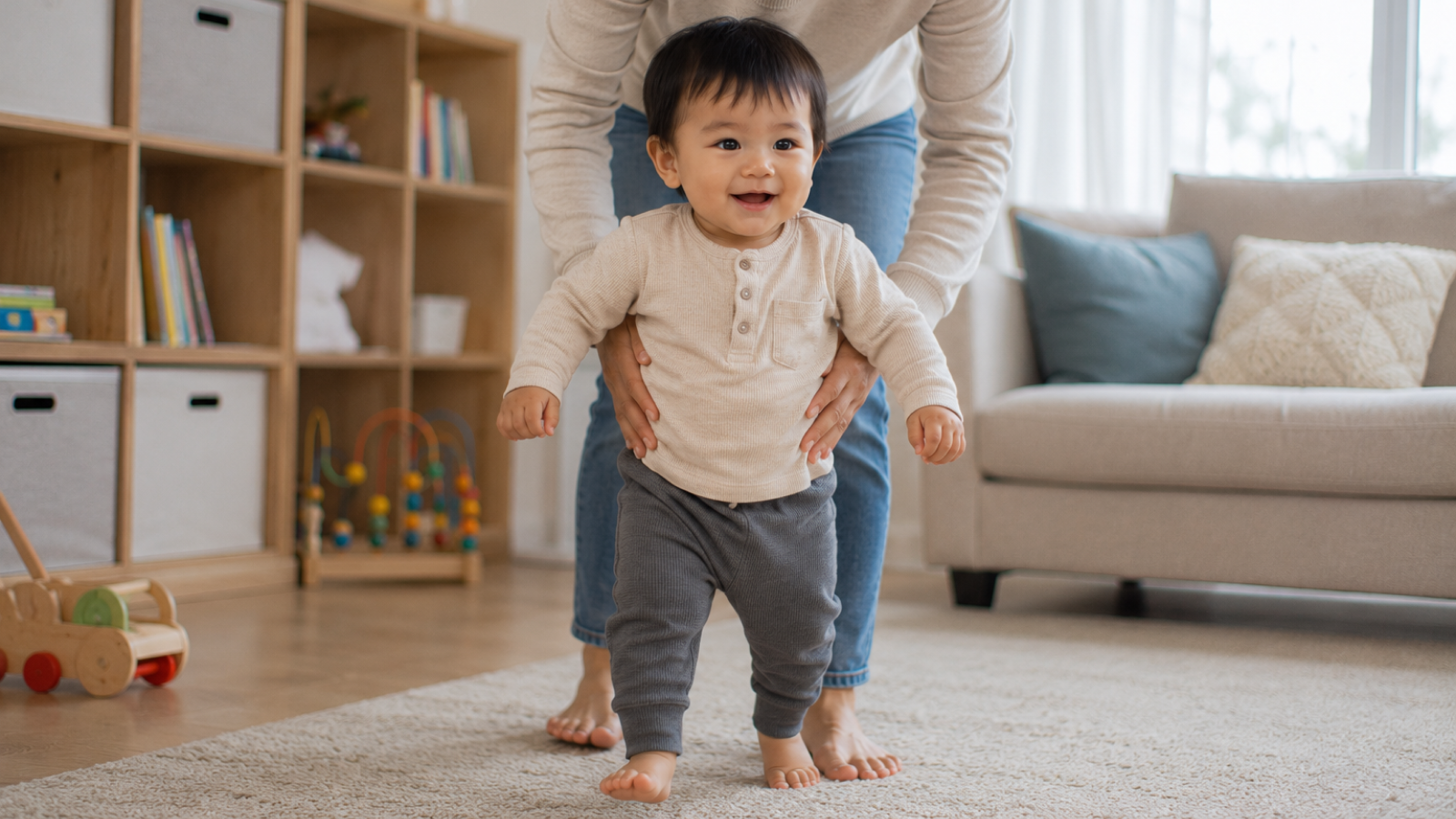
Few developmental milestones are compared among parents as often as learning to walk. However, children develop very differently, especially in the first two years of life. Some take their first independent steps before their first birthday, while others take significantly longer.
The timing of a child's first steps alone doesn't say much about their overall development. It's much more important that their motor skills continue to develop step by step.
When do children typically learn to walk?
Most children take their first independent steps between 10 and 18 months.
Before that, many skills develop in sequence:
- Rolling
- Sitting
- Crawling or creeping
- Pulling up on furniture
- Cruising along furniture
- Standing independently
- First independent steps
Not every child goes through these steps in the same order. Some crawl for a long time, others hardly crawl and start pulling up or walking directly. This can also be completely normal.
What developmental milestones are often part of this?
Many children show some typical milestones before walking independently.
Between 9 and 12 months
Many children:
- sit securely,
- move by crawling or creeping,
- pull themselves up on furniture,
- stand with support,
- cruise along furniture.
Between 12 and 18 months
During this time:
- many children stand independently,
- take their first steps without help,
- improve their balance daily,
- usually get up by themselves after a fall.
Between 18 and 24 months
Movements become more confident now.
Many children:
- walk smoothly,
- start to run,
- climb the first stairs with support,
- climb over low obstacles,
- carry toys while walking.
Does my child need to crawl?
No. Many parents believe that crawling is a necessary prerequisite for walking. In reality, there are many different ways to move.
Some children:
- creep,
- scoot on their bottom,
- roll,
- move sideways,
- or skip traditional crawling altogether.
What matters is not how your child moves, but that they increasingly move independently and develop new motor skills.
Why do children develop so differently?
Motor development depends on many factors.
For example, factors include:
- individual pace of development,
- muscle strength,
- balance,
- body size and build,
- temperament,
- the opportunity to move freely.
Therefore, differences of several months are often completely normal.
How you can support your child
Children learn to walk mainly through their own experimentation.
Helpful are:
- plenty of free movement on the floor,
- enough time without bouncers or walkers,
- barefoot walking or non-slip socks in safe indoor areas,
- secure furniture for pulling up,
- encouragement instead of pressure.
The more your child can try things on their own, the more confidently their motor skills will develop.
Does my child need walking aids?
So-called baby walkers or walking aids are not recommended.
They do not speed up learning to walk and increase the risk of falls and accidents.
It's safer for your child to develop their movements independently and train their own balance.
When should you consult the pediatrician?
A pediatric assessment is advisable if:
- your child is not moving independently by around 10 to 12 months,
- they show very one-sided movements,
- they lose previously acquired motor skills,
- they are not pulling up to stand or attempting to walk by 18 months,
- they cannot walk independently by around 24 months,
- or if you feel that their motor development is not progressing much overall.
Often, there is nothing serious behind these concerns. However, an examination can help better understand their development.
Comparisons rarely help
Especially when learning to walk, uncertainties can arise quickly.
Perhaps the neighbor's child is already walking confidently while yours is still crawling. This does not automatically mean your child is behind in development.
Children do not develop according to a fixed schedule. Some focus more on language first, others on motor skills or social abilities. What matters is the overall development of the child – not a single milestone.
Remember this
Most children learn to walk between 10 and 18 months. Some start earlier, others later – both can be normal. More important than the timing of the first steps is that your child continues to develop and enjoys exploring their environment independently. With patience, free movement, and a safe environment, you best support this development.