Your child seems to understand everything you say, points to objects, completes small tasks—but only speaks a few words? Many parents wonder in this situation: Is this still normal, or is language developing too slowly?
Between 18 months and 4 years old, language comprehension and active speaking often develop at different rates. Some children first build a large vocabulary "in their head" and only start speaking more later. Therefore, it's important not just how many words your child says, but how they communicate overall and whether their development continues to change.
Language comprehension and speaking don't always develop simultaneously
Children learn language in several steps.
First, they listen, recognize words, and understand more and more connections. Only then do they start using language themselves more frequently.
A child can already:
- understand simple instructions,
- correctly point to objects,
- respond to questions,
- express desires with gestures,
and still speak only a few words.
This alone is initially no cause for concern.
What you can observe
You might notice that your child:
- responds to their name,
- understands what you mean,
- shows things when you ask,
- follows everyday instructions,
- communicates with gestures,
- seeks eye contact,
- wants to make themselves understood,
- but speaks only a few words.
This combination is common among many children.
Why some children speak later
There are many reasons why children start speaking at different times.
For example:
- individual development,
- growing up multilingual,
- a more observant personality,
- different interests,
- temporary hearing problems, such as after ear infections.
The number of words spoken alone says little about overall language development.
What can support language development
Children learn language primarily in everyday life—not through exercises.
Especially helpful are:
- talking a lot with each other,
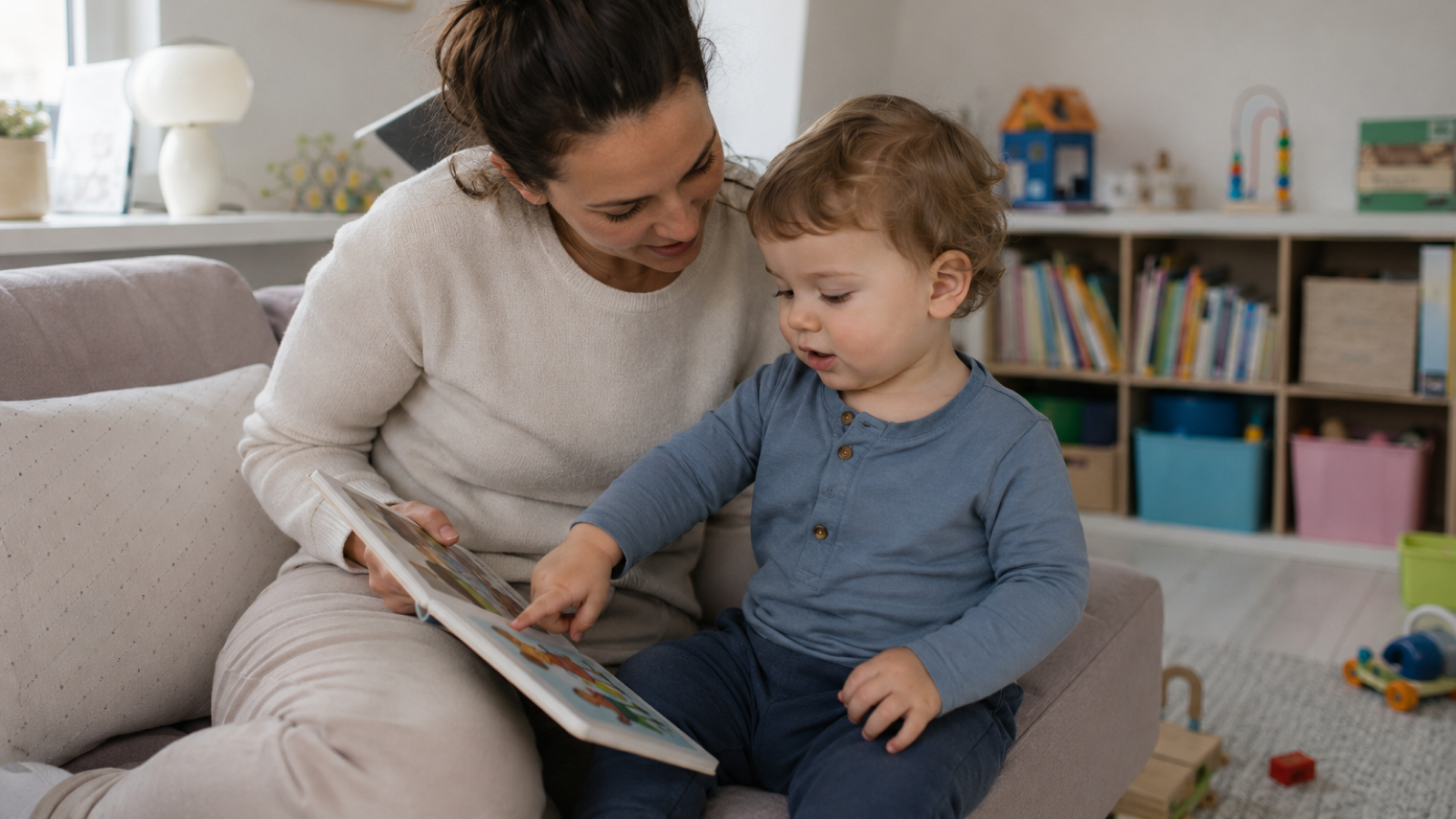
- looking at picture books together,
- naming things you are experiencing,
- asking questions and giving your child time to answer,
- singing, rhyming, and playing together,
- listening attentively, even if your child is still searching for words.
The more often language is experienced in shared situations, the easier it is for many children to speak.
What is usually less helpful
Well-intentioned corrections often do not lead to the desired success.
Therefore, try to avoid:
constantly prompting your child to repeat words,
correcting every word,
associating language with pressure or comparisons.
comparing your child to other children.
Children develop language best in a relaxed and appreciative environment.
When should you contact your pediatrician?
A pediatric evaluation is advisable if your child:
- does not use understandable words by around 18 months,
- does not form word combinations by about 2 years,
- loses words they have already learned,
- hardly understands simple instructions,
- seeks little eye contact or uses few gestures,
- or if you feel that their communication is not progressing.
The earlier potential issues are identified, the better children can be supported.
The overall picture is crucial
Children develop language at their own pace. Some speak early, while others observe for a long time before starting to use many words themselves. What matters is not just how much your child speaks, but how they communicate overall, understand language, and develop step by step.
If your child communicates curiously, seeks eye contact, and increasingly understands language, this often indicates age-appropriate development. If you have concerns or notice a lack of progress, your pediatrician is the right point of contact.