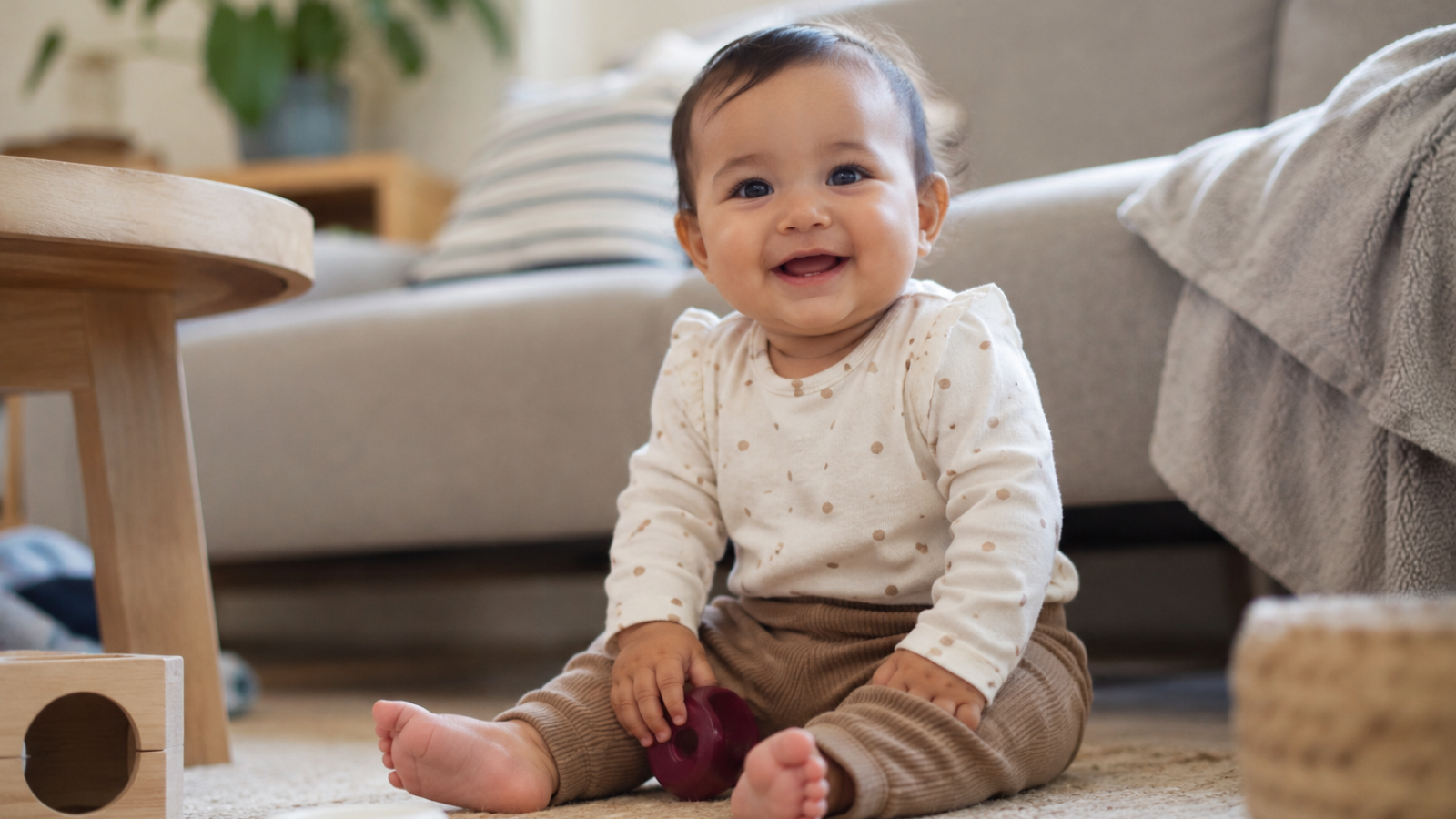
Other babies are already sitting up or crawling effortlessly around the house, while your child is still rolling or scooting. In the first year, many parents compare their child's motor development with others, which can quickly lead to uncertainty.
First of all: There is no fixed time when every baby must be able to sit or crawl. Motor development is very individual. Some children sit early, others crawl first. Some even skip the classic crawling altogether.
More important than a single milestone is that your baby continues to develop step by step overall.
When do babies learn to sit?
Many babies begin to sit independently between the 6th and 9th month.
Before this, they can usually:
- hold their head steadily,
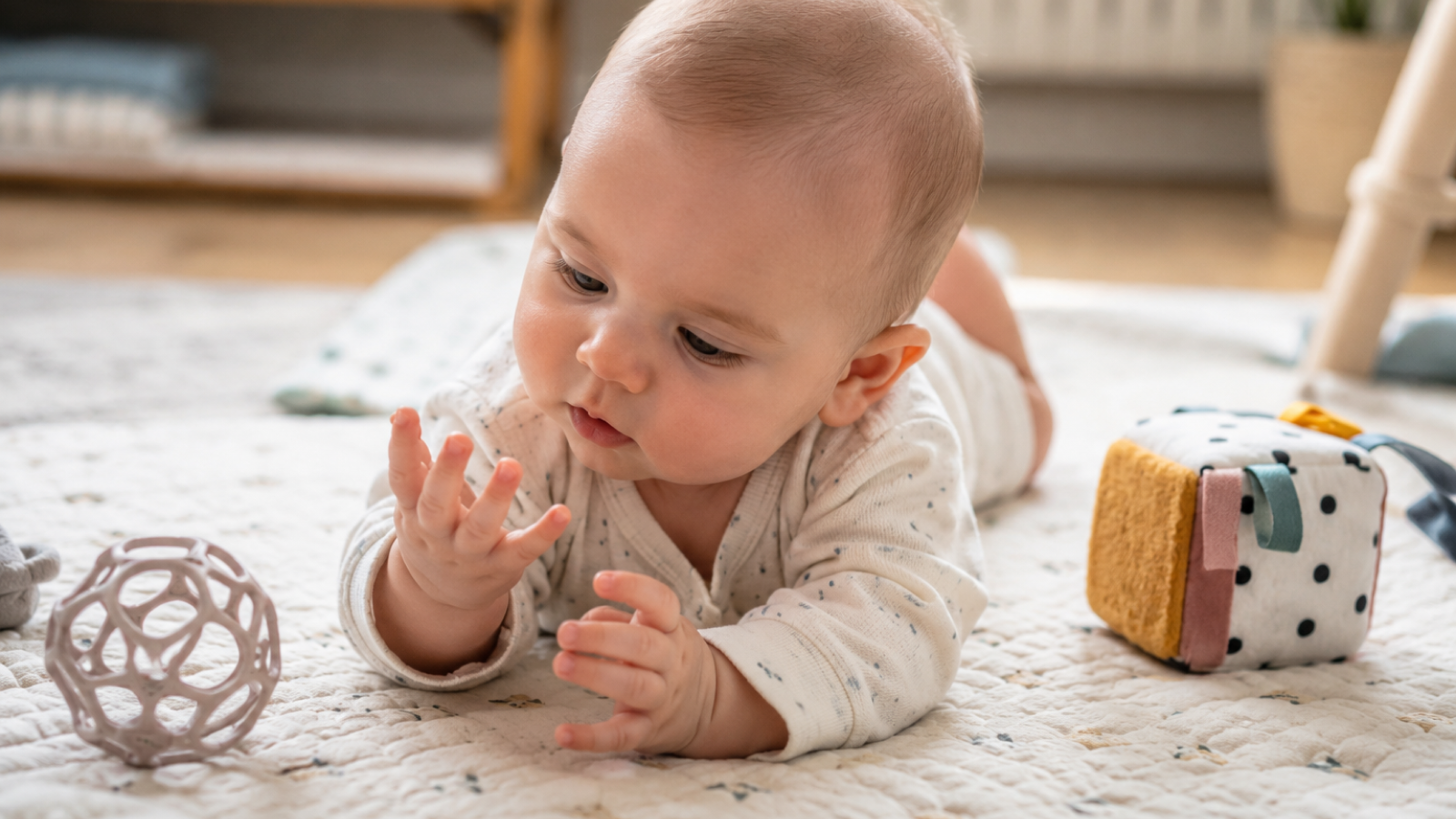
- support themselves well in a prone position,
- roll over,
- use their hands purposefully.
Free sitting means your baby can maintain balance without support for some time and stabilize themselves.
When do babies start crawling?
Classic crawling often develops between the 7th and 10th month.
Before that, many children already move in other ways:
- they roll through the room,
- scoot on their belly,
- slide on their bottom,
- spin around their own axis,
- or push themselves backward.
All these forms of movement can be part of normal development.
Does every baby have to crawl?
No. Not every child crawls in the classic hands-and-knees style. Some babies skip this phase and pull themselves up on furniture or start taking their first steps early.
What matters is not how your child moves, but that they increasingly enjoy exploring their surroundings independently.
What developmental steps precede sitting and crawling?
Motor skills build on each other.
Before sitting and crawling, many babies gradually develop:
- good head control,
- stable support in a prone position,
- rolling from back to belly and back again,
- purposeful grasping,
- weight shifting,
- initial turning and support movements.
This development does not occur in the same order for every child.
Why should you avoid sitting your baby up?
Many parents sit their baby up before they can get into this position on their own.
For motor development, it is better if your child learns to sit by themselves. This way, they train important muscle groups and learn to control their balance independently.
A baby who can sit up on their own can usually leave the position safely as well.
How you can support motor development
Babies learn movement primarily through their own experimentation.
Helpful tips include:
- Daily free movement time on a safe surface,
- Regular tummy time while your baby is awake,
- Placing toys just out of reach,
- Providing enough space for rolling, turning, and crawling,
- Minimizing time in bouncers, car seats, or other seats outside of car rides.
The more your baby can experiment on their own, the better they can develop new movements.
What should you avoid?
Well-intentioned support isn't always helpful.
Try to avoid:
- Sitting your baby up for long periods if they can't do it themselves yet,
- Using baby walkers,
- Constantly guiding or correcting movements.
Babies learn motor skills best at their own pace.
When should you consult your pediatrician?
A pediatric assessment is advisable if your baby:
- Cannot hold their head steadily by around 6 months,
- Hardly turns or moves by about 9 months,
- Shows very one-sided movements,
- Loses skills they have already learned,
- Cannot sit up independently by about 10 months,
- Or does not move independently at all by about 12 months.
Even if you feel that your baby's motor development is not progressing, regardless of age, it is worth consulting a doctor.
Comparisons rarely help
Especially in the first year, children often differ by several months in their motor development.
A baby who sits or crawls later is not necessarily developing more slowly. Some children initially focus more on language, fine motor skills, or social development.
The overall developmental progress is what matters – not a single milestone.
What you should know
Most babies learn to sit independently between 6 and 9 months and start crawling between 7 and 10 months. Many first use other forms of movement or skip traditional crawling altogether. Plenty of free movement, patience, and a safe environment usually support motor development better than targeted exercises or comparisons with other children.