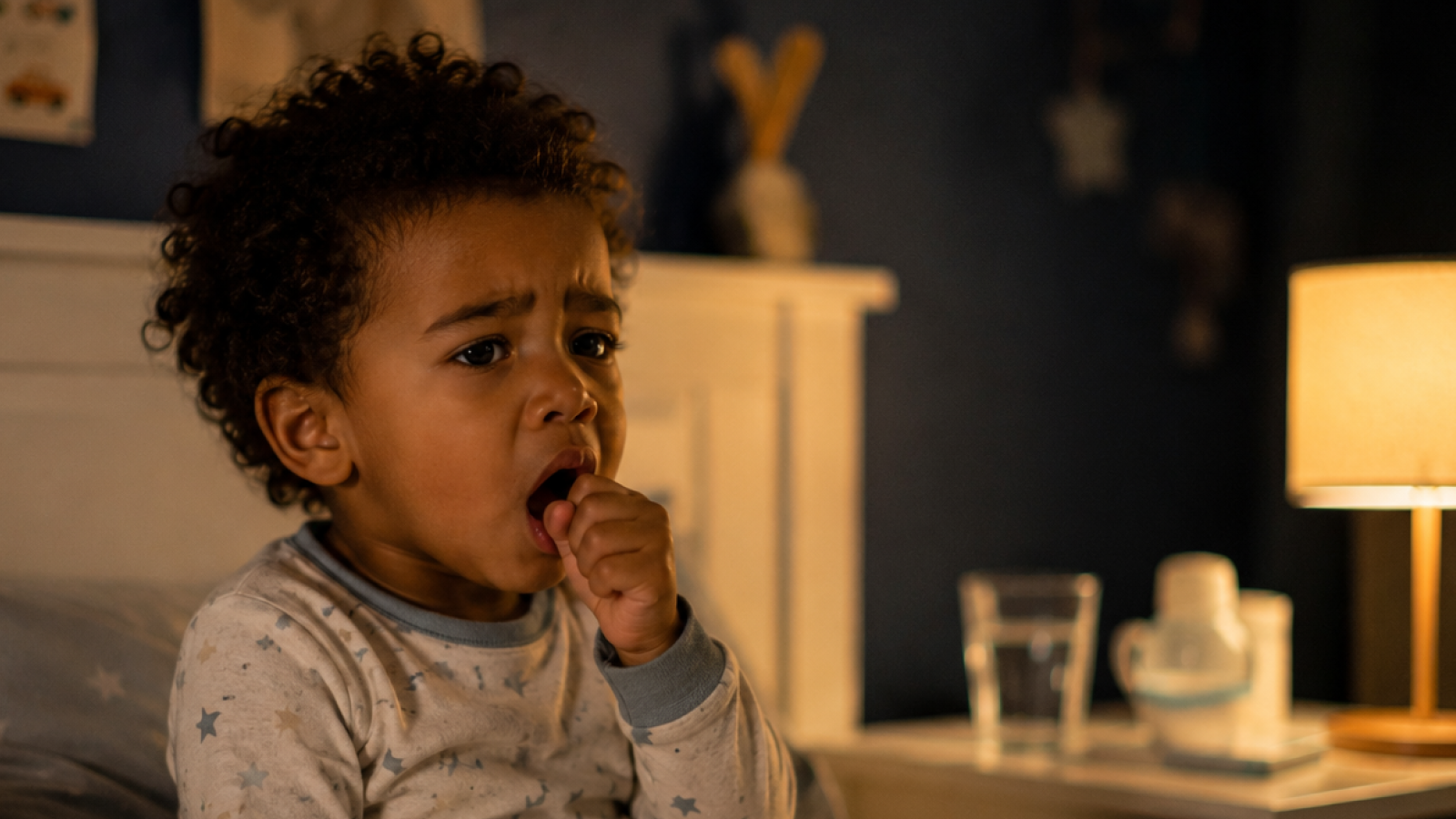
When a child suddenly wakes up at night with a barking cough, most parents get frightened. The cough sounds unusually loud, the voice is hoarse, and sometimes breathing in seems difficult. Worry quickly follows: Is this dangerous?
The good news: A barking cough is often caused by a pseudo-croup attack (Pseudokrupp). It sounds dramatic, but in most cases it is mild and improves again within a short time. What matters most is how well your child can still breathe.
How can you recognise pseudo-croup?
Pseudo-croup mainly affects children between around 6 months and 6 years. It is usually triggered by a viral infection that makes the larynx and upper airways swell.
Typical signs are:
- a sudden onset of barking cough
- hoarse voice
- a whistling or pulling sound when breathing in
- symptoms mainly at night
- often a mild runny nose or cough the day before
Many children seem almost well again during the day and only develop symptoms at night.
Why does pseudo-croup often happen at night?
At night, the mucous membranes swell more than during the day due to hormonal changes. At the same time, children lie flat in bed and their airways are narrower than adults’. Even a small swelling can therefore cause clearly audible breathing noises.
This also explains why the cough often starts suddenly and feels so threatening for parents.
How can you tell the difference from a normal cold?
A normal cold usually develops slowly. Typical symptoms are a runny nose, cough and sometimes fever.
With pseudo-croup, the barking cough is the most noticeable symptom. Hoarseness and a whistling or pulling sound when breathing in are also common.
What helps with a mild pseudo-croup attack?
The most important thing is to stay as calm as possible. Children often pick up their parents’ tension very quickly—and anxiety can make shortness of breath worse.
These things can help:
- hold your child upright or sit them up
- stay with them calmly and comfort them
- provide fresh, pleasantly cool air, for example by an open window or on the balcony
- offer something to drink if your child wants to drink
In the past, humidifying the air with hot steam baths was often recommended. However, there is no convincing scientific evidence for this.
When should you get help immediately?
Most pseudo-croup attacks are mild. But there are warning signs where your child should be seen by a medical professional straight away.
Get medical help immediately if your child:
is visibly struggling for air
breathes in loudly with a whistling or pulling sound even when resting
can hardly speak or cry
looks bluish around the mouth or lips
becomes unusually sleepy or is hardly responsive
is very restless and their breathing gets worse quickly
Even if you are unsure, or you feel that your child is clearly getting less air, you should not wait.
Can a pseudocroup attack happen again?
Yes. Some children have only one attack, while others react several times in the first years of life to viral infections with pseudocroup.
However, this does not automatically mean there is a chronic condition behind it. As children get older, their airways widen, and pseudocroup happens much less often.
What helps if your child often has pseudocroup?
If your child has had a pseudocroup attack before, it can be helpful to talk to your pediatrician’s practice about what you can do if it happens again. Some families are given an emergency medicine for this situation, which can be used when needed following medical instructions.
Summary
A barking cough often sounds more dramatic than it actually is. In most cases, the symptoms are caused by a mild pseudocroup attack. What matters is not the cough itself, but how well your child is still breathing. As long as your child can breathe calmly between coughing fits, responds to you, and can be soothed again, pseudocroup often goes smoothly.
Stay calm – even next time
With the tio App, you can easily document barking cough, breathing, fever, and how the symptoms develop. You also get medically reviewed guidance on what to watch for with pseudocroup and which warning signs need immediate medical assessment. This helps you be better prepared if another attack happens.